
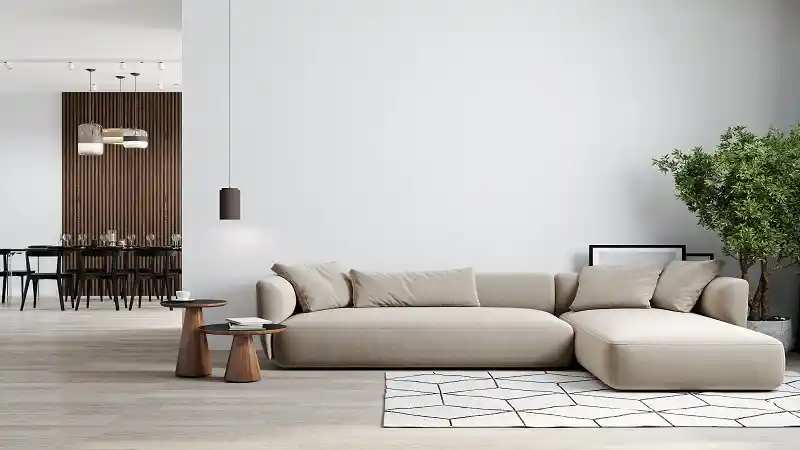
Comfort promises warmth, softness, and ease. In practice, many homes lean too far in one direction: beautifully styled interiors that feel cold, or cozy rooms that feel cluttered. The real challenge is not choosing between minimalism and comfort, but structuring a space so both can coexist.
Why Minimalism Often Feels Incomplete in Real Homes
Minimalist spaces are often simultaneously under-designed and over-designed. Overly minimal interiors can edit out the function along with the aesthetics. If a side table is removed to appear more open, urban dwellers end up without a place to put their coffee cup or laptop. Anyone who’s tried to live in a photo-ready space can attest to how annoying it is to have to always bend over to the ground to retrieve a book or cup.
Another issue is when we remove all comfortable touches. Hard floors, bare walls, and hard-edge furniture may photograph well, but have miserable acoustics. A living room with no rugs or upholstered items might look spare and neat, but quickly becomes unbearable in a matter of days.
Simple layouts also disrupt circulation. Pushing furniture against the walls can feel minimal since it’s out of the way, but it creates awkward dead space in the middle. And with hidden storage, the problem can get worse—beautiful cabinetry that requires moving furniture to open is impractical in daily life.
Minimalism fails when it ignores how people actually move, sit, and store belongings.
What Comfort Really Means in Design Terms
Comfort can be designed for. It all starts with ergonomics. A sleek low-line sofa with shallow seating seems to spell sophistication, but replace it with a deeper-seated style with lumbar support, and suddenly it’s more comfortable to live with. Chair seat heights, arm rests, and firmness of cushions all need to be considered.
Lighting is just as important. No amount of strategically placed pendants is going to make a room comfortable if that’s the only light source. Ambient ceiling fittings, task-focused pendants near seating, and lamps providing depth and atmosphere make for a versatile space.
Thermal comfort is easily the most overlooked. Rugs on hard floors will cut down heat loss, heavy curtains reduce draughts, while insulated window coverings keep rooms thermally stable. A contrast of textures also impacts the sense of comfort a space provides: pair linen-furnished seating with timber surfaces, and nominate a single fully – upholstered armchair as the comfort hero to boost tactility minus the clutter.
For homeowners who find themselves holding onto meaningful or seasonal items that don’t fit the new layout, using self storage units Airdrie can help maintain that balance. Keeping rarely used furniture, décor, or household items stored off-site allows you to preserve comfort at home without compromising clean lines and functional flow.
Comfort is not decorative excess; it is physical and sensory design.
The Design Framework for Balancing Both
A practical structure prevents extremes.
- Anchor Piece Rule: At least one comfort piece per room. For instance, in a minimal living area, a statement armchair or a deep-seated sofa.
- Functional Negative Space: Space should improve the dynamics of a space, not just exist for appearance. No walkway smaller than 80–90cm.
- Hidden Storage Ratio: 60% hidden storage, 40% open shelving. This keeps the space neat without compromising daily convenience.
- Texture Layering vs Clutter: Stick to three key large-scale materials, such as oak, linen, matte metal, to keep visual “noise” to a minimum.
- Lighting as a Sculptural Building Block: Use light as a space-defining element.
Planning Before Decorating
Balancing minimalism and comfort begins before shopping. Rooms should be visualized to understand proportions and flow before making costly planning mistakes. A room planner tool allows homeowners to understand scale, adjust layout, and ensure good flow before moving forward.
Seeing it in plan helps determine if a sofa overwhelms a room, if storage blocks pathways, or if a bedroom is too tight on walking space. This prevents sterile minimalism and overdone layouts.
Case Examples — Minimal and Comfortable
In a small apartment, a minimalist neutral palette, a deep clean-lined sofa, and under-bed storage produce clarity without coldness. A layered rug adds texture while keeping the space airy.
In a Scandinavian-style bedroom, simple lines and few graphics create an uncluttered feel, while blankets, pillows, a padded headboard, and heavy drapes absorb sound.
A modern home office may have minimal furniture, but a good desk and ergonomic chair offer comfort. Layered lighting prevents glare. It avoids embellishment that might look comfortable but adds nothing.
Closing
Minimalism and comfort are not at odds; they are structural decisions. The right balance helps create good flow, select materials with desired texture, and design around human interaction. Intentional minimalism creates clarity and comfort ensures the space can be lived in. Draft before deciding, and base selections on function rather than